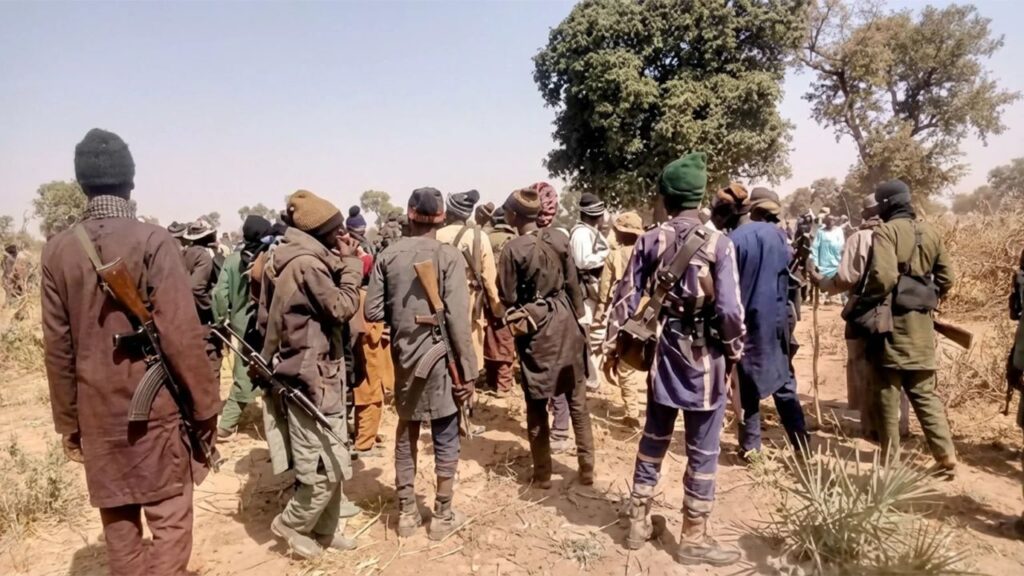
A 55-year-old woman in Zamfara State, Fatima, has recounted the devastating experience of bandit attacks that forced her and other residents to flee their communities.
Speaking to the BBC Hausa service, Fatima said bandits attacked her village around 2 a.m., dividing themselves into three groups to surround the community and block escape routes.
She said residents faced deadly choices, as those who hid indoors had their homes set on fire, while those who attempted to escape were shot.
Fatima claimed that about 70 people, including children, were killed during an attack on Bia Buki village in June. She said her husband and six of her seven siblings were among those killed.
According to her, the attackers sometimes arrived on as many as 100 motorcycles, with about three people riding on each motorcycle.
Following the attack, Fatima and other residents fled into a nearby forest with their children before eventually making their way to Gusau, the Zamfara State capital.
She now lives in a temporary camp with her seven children, aged between nine and 30, where she said food, shelter and other forms of assistance remained inadequate.
Fatima also alleged that 22 displaced children who were sent to gather firewood for sale were abducted by bandits.
She said security had improved slightly following patrols by soldiers and government-backed vigilantes, but residents remained afraid of returning home.
Data cited by the BBC showed that bandit attacks in north-western Nigeria increased significantly in the first half of 2026. The Armed Conflict Location & Event Data project reported a 78 per cent rise in attacks compared with the same period in 2025.
SBM Intelligence also estimated that 7,825 people were kidnapped across Nigeria between July 2025 and June 2026, while about N7.8 billion was reportedly paid as ransom.
Security analyst Malik Samuel of Good Governance Africa said no part of northern Nigeria was currently completely free from large-scale kidnapping.
Fatima said she had been told that bandits had established a camp close to her community, with one of their leaders allegedly acting as a de facto authority and settling disputes among residents.
She said several neighbouring villages had been completely deserted, adding that returning home without adequate security would expose residents to further attacks and hardship.
Despite her desire to return, Fatima said the continuing insecurity had left her and thousands of other displaced Nigerians uncertain about when they could safely return to their communities.