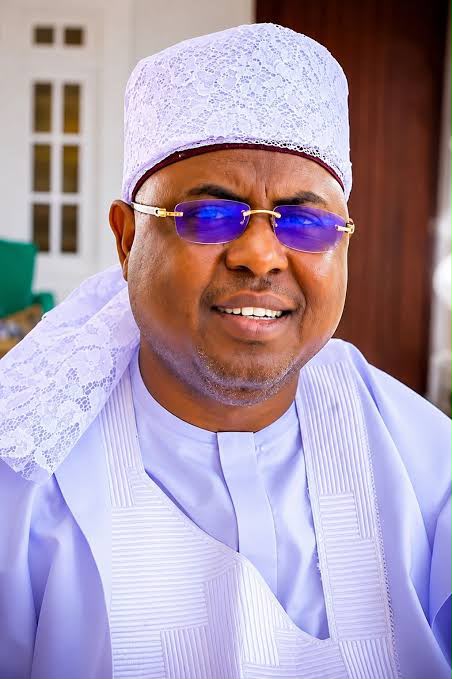
Three weeks after President Bola Tinubu announced the appointment of Dr Abdulrazak Namdas as Director-General of the Border Communities Development Agency (BCDA), the Secretary to the Government of the Federation (SGF), George Akume, has been accused of withholding his appointment letter.
The development has sparked a leadership crisis within the agency, as the immediate past chief executive, Dr Dakorinama George, continues to perform official duties despite the President’s directive appointing a new head.
The Presidency had, on June 26, announced Namdas’ appointment through a statement issued by the President’s Special Adviser on Information and Strategy, Bayo Onanuga. The statement said Namdas, a former spokesperson for the House of Representatives, was appointed to replace George, who had resigned to contest an elective position in his home state.
The statement read in part: “President Bola Ahmed Tinubu has appointed Abdulrazak Sa’ad Namdas as the new Director-General of the Border Communities Development Agency. Dr Namdas replaces Dr Dakorinama Alabo George, who resigned to contest for an elective post in his home state.
“President Tinubu also announced the appointment of Hon. Patrick Obahiagbon as Executive Director, Strategy and Commercial, of the Niger Delta Power Holding Company. He also reappointed Mr Chukwuma Umeoji as Executive Director, Corporate Services, of the NDPHC. The appointments take immediate effect.”
However, more than three weeks after the announcement, Sunday PUNCH gathered that Namdas has yet to assume office because the formal appointment letter conveying the President’s directive has not been issued.
Meanwhile, George has continued to occupy the office, preside over official engagements and represent the agency at high level government meetings.
One such engagement took place on July 9, when George met with the Minister of Finance and Coordinating Minister of the Economy, Wale Edun, in Abuja to seek intervention for the release of funds for BCDA projects.
A statement published by Rivers-based news platform, Port Harcourt Force, alongside photographs from the meeting, repeatedly described George as the Executive Secretary of the agency.
According to the statement, George congratulated the minister on his appointment and appealed for the timely release of budgetary allocations for ongoing infrastructure projects in border communities across the country.
He was also quoted as saying the BCDA had facilitated a proposed $2 billion Chinese investment in a livestock processing hub in Maigatari, Jigawa State, and was working with security agencies on plans to establish a Border Communities Intelligence Corps.
The continued discharge of official duties by George has raised questions over who currently exercises lawful authority over the agency.
Speaking during an interview on Trust TV monitored by Sunday PUNCH on Thursday, APC chieftain Hamman Yero alleged that the delay was caused by the SGF’s failure to transmit the President’s appointment.
He questioned why Namdas had yet to receive his appointment letter despite the Presidency’s public announcement.
“This is a mandate given to the President by Nigerians. On whose mandate is the SGF acting?” Yero asked.
“If the President directs that Namdas should be appointed and the SGF keeps the appointment letter without releasing it, then serious constitutional and administrative questions arise.”
According to him, once a presidential appointment is approved, the process should seamlessly move from presidential approval to the issuance of an appointment letter through the Office of the Secretary to the Government of the Federation.
“It is the Chief of Staff who normally transmits presidential approvals to the SGF for implementation. Is the Chief of Staff aware that Namdas has still not received his appointment letter? If he wasn’t aware before, he certainly should be aware now,” he added.
Yero also dismissed reports suggesting that George’s appointment had been restored, arguing that the lingering uncertainty raised broader concerns about compliance with presidential directives.
The controversy mirrors a similar leadership dispute that occurred at the Nigerian Postal Service (NIPOST) in October 2023.
At the time, President Tinubu appointed Tola Odeyemi as Postmaster-General and Chief Executive Officer of NIPOST after removing Sunday Adepoju. Days later, NIPOST announced that Adepoju had been reinstated, creating confusion over the agency’s leadership.
The crisis escalated when workers locked the agency’s headquarters in Abuja and resisted Odeyemi’s resumption before the Presidency reaffirmed her appointment. She eventually assumed office on October 16, 2023, bringing the dispute to an end.
Sunday PUNCH also learnt from multiple sources within the BCDA that George never fully relinquished control of the agency after resigning to pursue the APC governorship ticket in Rivers State.
One senior official, who requested anonymity because he was not authorised to speak publicly, alleged that George quietly returned to the agency after losing the APC governorship primary.
“He resigned to contest the governorship. After losing, he simply returned and resumed activities without any formal handover,” the source claimed.
The official further alleged that George continued to enjoy strong political backing within the administration.
According to the source, George’s continued presence at the agency is linked to his relationship with the Minister of the Federal Capital Territory, Nyesom Wike, under whom he served as Rivers State Commissioner for Works.
“It was Wike who nominated him for the BCDA appointment in 2024. That relationship explains why he has remained influential despite his resignation,” the source alleged.
Sunday PUNCH could not independently verify the claim.
However, one of George’s allies dismissed the allegation as mere speculation.
“Wike is also an appointee of the President and cannot wield such powers,” the ally said.
When contacted, Presidential spokesman Bayo Onanuga maintained that the President’s decision remained unchanged.
“As far as I know, the President has not changed his mind. Namdas remains the Executive Secretary of the agency.
“All these things they are talking about, they don’t know what they are talking about. The President has not changed his mind about the appointment of Namdas as the head of that border agency,” he said.
Asked why Namdas had yet to assume office, Onanuga explained that the issuance of the appointment letter falls under the responsibility of the Office of the Secretary to the Government of the Federation.
“His appointment has been communicated to the Office of the SGF, so the SGF has to give him a letter,” he stated.
He, however, declined to comment on why the letter had not yet been issued or whether the Presidency had demanded an explanation from the SGF.
The Head of Information and Public Relations at the Office of the SGF, Christopher Ugwuegbulam, said an official response would only be provided after receiving a formal inquiry.
“What I normally prefer is for you to write to us and we will sit down to give you a response,” he said.
Similarly, the SGF’s Special Adviser on Media and Publicity, Yomi Odunuga, said he had no information on the matter.
Efforts to obtain a reaction from George were unsuccessful, as he neither answered calls nor responded to text and WhatsApp messages sent to him before the report was filed.
Reacting to the development, constitutional lawyer Suraj Bamidele said the President has the constitutional authority to appoint and remove heads of federal agencies.
“In the BCDA case, the issue is no longer simply who the President appointed. It is whether there is a clear, transparent and enforceable system for ensuring that presidential appointments are implemented consistently across government institutions.
“Where an appointment is announced by the Presidency but its implementation is delayed or disputed, it creates legal uncertainty that can affect the validity of administrative decisions taken during that period,” he said.
Public affairs analyst Sunday Awosika described the situation as a serious governance concern.
“This allegation is a very bad commentary for our country. We have yet to conclude discussions surrounding the controversy over the alleged Presidential Foreign Investment Promotion Council, and now another issue has emerged regarding compliance with presidential appointments,” he said.
“I think the President needs to rein in some officials because there are established mechanisms for managing government agencies. It will be difficult to understand how someone whose resignation was accepted and whose replacement has been publicly announced can continue to function in that office,” he added.
Another analyst, Abdulrasaq Rasheed, said the incident reflected a lack of coordination within the government.
“For me, the role of the Chief of Staff is different from that of the SGF. The Chief of Staff serves as the President’s private secretary, while all correspondence relating to appointments should ordinarily be handled by the Office of the Secretary to the Government because it coordinates the ministries, departments and agencies.
“The SGF is perhaps exercising restraint. Otherwise, there would have been a clash of personalities over what appears to be an overlap in responsibilities,” he said.
The African Democratic Congress (ADC) also weighed in, calling on President Tinubu to resign if he could no longer exercise effective control over his administration.
In a statement issued on Friday by its National Publicity Secretary, Bolaji Abdullahi, the opposition party urged the National Assembly to invoke its constitutional oversight powers to determine whether the President remained capable of effectively discharging his responsibilities.
The party argued that the BCDA controversy was not an isolated incident but part of a growing pattern of confusion surrounding presidential appointments and executive authority.
It also referenced the controversy over the alleged Presidential Foreign Investment Promotion Council, describing it as a “phantom” body that reportedly operated at the highest levels of government despite questions over its legal status.