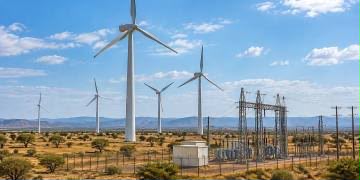
Nigeria’s efforts to develop renewable energy have suffered major setbacks, with the stalled Lambar-Rimi wind farm project in Katsina State highlighting the challenges facing the sector.
The 10-megawatt project was initiated by the Katsina State Government in 2005 before being taken over by the Federal Government in 2007. In 2010, a French company, Vergnet S.A., was awarded a contract to construct 37 wind turbines within 24 months.
Despite several years of work, the project remains incomplete. Government reports described it as about 95 per cent complete in 2017, but the Kano Electricity Distribution Company reported in 2023 that it was only 80 per cent complete. The turbines have since deteriorated and require extensive rehabilitation.
In 2025, the Katsina State Government reacquired the facility and announced plans to combine it with a 10-megawatt solar power plant. The state expects the hybrid project to begin operations in the fourth quarter of 2026.
The challenges extend beyond Katsina. Several other wind and solar projects across Nigeria have remained undeveloped or have been cancelled, reflecting persistent problems with financing, infrastructure, regulation and project coordination.
Experts say Nigeria lacks the systems needed to turn renewable energy plans into viable projects. They identify policy uncertainty, limited access to financing, inadequate wind-resource data, grid constraints and difficulties securing land as major obstacles to investment.
They also stress that renewable energy projects require reliable transmission infrastructure, clear power-purchase agreements and credible buyers to ensure investors can recover their costs.
Egypt provides a contrasting example, having expanded its renewable energy sector through clearer regulations, competitive bidding, investment support and improvements to electricity transmission infrastructure. Its Benban solar park, which has a combined capacity of 750 megawatts, was connected to the national grid in 2019.
Industry stakeholders say Nigeria can adapt some of these approaches while developing solutions suited to its own electricity market, including mini-grids and commercial and industrial renewable energy projects.
Local manufacturing is another challenge. Although Nigerian companies can produce or assemble some solar equipment, specialised technologies and key components remain heavily dependent on imports. Manufacturers face high financing costs, foreign-exchange instability, unreliable electricity and uncertainty about demand.
The government’s Distributed Access through Renewable Energy Scale-up programme aims to expand electricity access to more than 17.5 million Nigerians through connections and mini-grids. A proposed solar manufacturing facility involving the Rural Electrification Agency, Infrastructure Corporation of Nigeria and Dutch company Solarge BV is also intended to support local production.
Industry experts recommend gradually increasing local manufacturing, starting with solar-module assembly, mounting structures, cables and battery packs, while developing domestic capacity for wind-turbine foundations, steel towers, installation and maintenance.
They say Nigeria’s renewable energy industry will only grow sustainably if projects are supported by reliable financing, stable regulations, transmission infrastructure, local manufacturing and long-term maintenance plans.