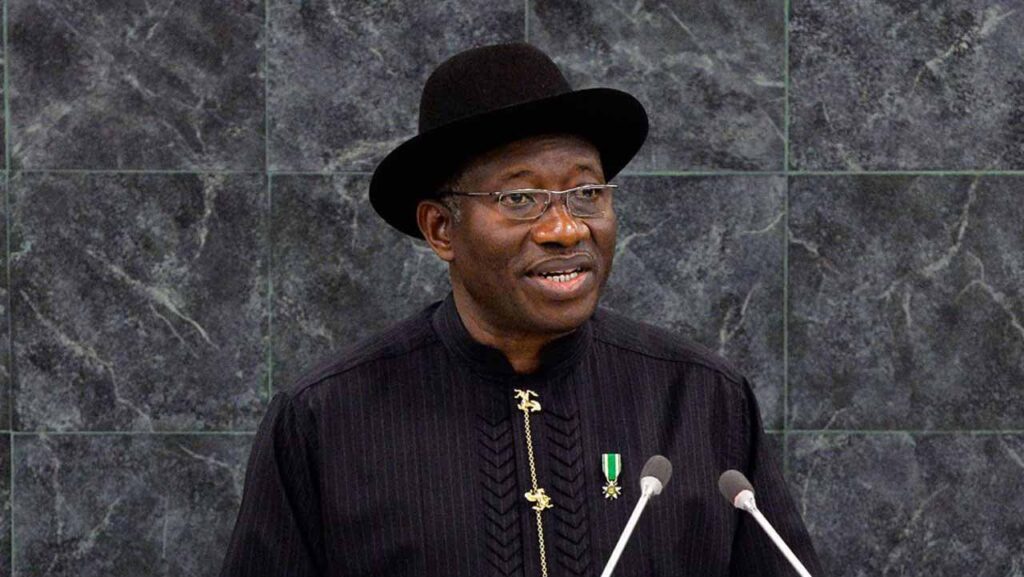
Former President Goodluck Jonathan has revealed that Nigeria’s local content policy in the oil and gas sector was inspired by China’s success in developing its domestic petroleum industry.
Jonathan made the disclosure at the SweetCrude Dialogue 2026 held at the Nigerian Content Tower in Yenagoa, Bayelsa State, where he reflected on the enactment of the Nigerian Oil and Gas Industry Content Development (NOGICD) Act, 2010, and the progress made by the Nigerian Content Development and Monitoring Board (NCDMB).
According to the former president, the idea for the local content law took shape after a visit to China during his time as Deputy Governor of Bayelsa State, where he observed that virtually every aspect of the country’s oil industry relied on locally manufactured equipment, expertise and technology.
He said the experience made him question why Nigeria, despite discovering crude oil around the same period as China, remained heavily dependent on foreign technology and services in its petroleum sector.
Jonathan recalled signing the NOGICD Bill into law in April 2010, describing it as one of the most significant decisions of his administration because of its long-term impact on Nigeria’s economy and indigenous participation in the oil and gas industry.
He commended the NCDMB for driving local content development over the years and praised the organisers of the SweetCrude Dialogue for creating a platform to discuss the future of Nigeria’s oil and gas industry.
Speaking at the event, the Executive Secretary of the NCDMB, Felix Omatsola Ogbe, represented by the Board’s Director of Monitoring and Evaluation, Esueme Dan Kikile, said local content participation in Nigeria’s oil and gas industry had risen from less than five per cent in 2010 to 61 per cent in 2026.
He attributed the growth to the Board’s enforcement of local content policies, human capacity development programmes and investments in strategic infrastructure aimed at strengthening indigenous participation across the sector.
Among the projects highlighted were the 17-storey Nigerian Content Tower in Yenagoa, the Oloibiri Museum and Research Centre, the Nigerian Oil and Gas Parks Scheme in Bayelsa and Cross River states, gas processing infrastructure in Bayelsa, the Brass Shipyard project and the NCDMB’s Back-to-the-Creek Initiative.
Ogbe said the initiatives were helping to transform oil-producing communities into centres of industrial development, technology and economic growth.
Also speaking, Bayelsa State Governor Douye Diri, represented by Deputy Governor Lawrence Ewhrudjakpo, said Bayelsa was a fitting venue for discussions marking 70 years of oil and gas production in Nigeria because the state’s Oloibiri community is where crude oil was first discovered.
Delta State Governor Sheriff Oborevwori, represented by his Chief of Staff, Johnson Erijo, urged stakeholders to remain committed to improving the welfare of host communities, while the Niger Delta Development Commission (NDDC) called for continued efforts to ensure oil-producing communities benefit from the region’s natural resources.
Delivering the keynote address, Professor Ibibia Lucky Worika of Rivers State University said the oil and gas industry has shaped Nigeria’s economy, politics and development over the past seven decades but noted that the Niger Delta has also borne the environmental and social costs of oil exploration.
He stressed the need for environmental justice, describing it as essential to sustainable development and the future of the region.
Earlier, the convener of De Mangrove Conversations, Biobele Da-Wariboko, said the dialogue was created to preserve the history and contributions of the Niger Delta to Nigeria’s development while encouraging conversations on the future of the country’s energy sector.