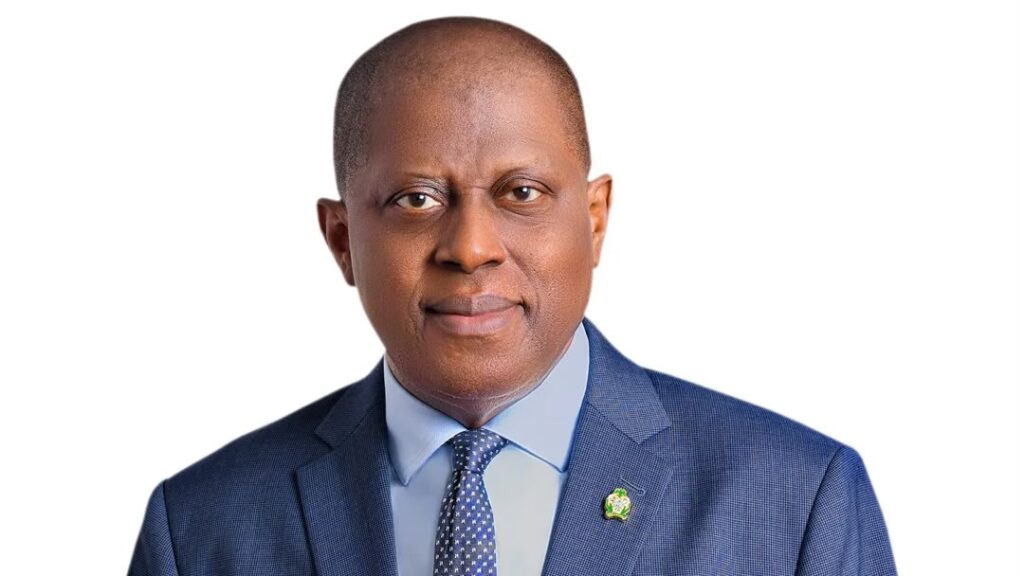
Governor of the Central Bank of Nigeria (CBN), Olayemi Cardoso, has said the naira should remain market-driven and competitive rather than being artificially supported, as the apex bank retained its benchmark interest rate and reaffirmed its commitment to reducing inflation to single digits.
Cardoso made the remarks after the Monetary Policy Committee (MPC) meeting in Abuja on Tuesday, where the committee left the Monetary Policy Rate (MPR) unchanged at 26.5 per cent.
His comments come weeks after the International Monetary Fund (IMF) said the naira remains undervalued despite recent gains against the United States dollar in both the official and parallel foreign exchange markets.
The IMF estimated that the naira is trading about 25.6 per cent below its value based on Nigeria’s economic fundamentals, even after recent foreign exchange reforms introduced by the Federal Government.
Responding to the assessment, Cardoso defended the CBN’s exchange-rate reforms, insisting that the bank remains committed to a transparent and liquid foreign exchange market where prices are determined by willing buyers and willing sellers.
“Our focus is to sustain a transparent and liquid market driven by willing buyers and willing sellers. Nigeria needs a competitive currency whose value is determined by economic fundamentals such as stronger oil and non-oil exports, increased foreign direct investment, improved domestic productivity and lower import dependence,” he said.
He added that the foreign exchange market has become more transparent, with daily turnover at times exceeding one billion dollars, reflecting growing confidence in the reforms introduced by the apex bank.
Announcing the outcome of the MPC meeting, Cardoso said the committee retained the Monetary Policy Rate at 26.5 per cent, maintained the asymmetric corridor at +50/-450 basis points, kept the Cash Reserve Ratio (CRR) at 45 per cent for deposit money banks and 16 per cent for merchant banks, retained the 75 per cent CRR on non-Treasury Single Account public sector deposits, and left the liquidity ratio unchanged at 30 per cent.
He explained that the decision followed a careful assessment of moderating domestic inflation and growing global uncertainties, particularly renewed tensions in the Middle East, which could trigger higher energy prices and increase inflationary pressures.
According to Cardoso, headline inflation eased slightly to 15.91 per cent in June from 15.93 per cent in May, ending three consecutive months of increases. Core inflation also declined to 15.92 per cent from 16.82 per cent, supported largely by exchange-rate stability.
However, he noted that food inflation rose to 17.52 per cent due to supply disruptions in major food-producing areas and higher transportation costs.
He said the moderation in inflation suggests that the central bank’s monetary tightening measures are beginning to deliver results, despite external challenges.
“We are pleased that inflation has moderated, albeit slightly. That gives us an indication that the tools we have implemented so far are beginning to produce results,” Cardoso said.
He acknowledged that the conflict in the Middle East had slowed the pace of disinflation but reaffirmed the CBN’s determination to restore price stability.
“We will do what is necessary to contain inflation and bring it down to single digits, which remains our target,” he added.
The MPC projected that inflation would continue to ease over the medium term, supported by exchange-rate stability, the delayed effects of previous monetary tightening and improved food supply during the harvest season. It, however, warned that a prolonged escalation of the Middle East conflict remains a major risk to the outlook.
Cardoso also highlighted improvements in key macroeconomic indicators, revealing that Nigeria’s gross external reserves increased to $52.52 billion as of July 17, up from $50.47 billion at the end of May, providing enough cover for about 11 months of imports.
He further disclosed that the Purchasing Managers’ Index (PMI) returned to expansion territory at 50.1 in June, indicating improving business activity.
The CBN governor stressed the need for stronger coordination between fiscal and monetary authorities to improve the effectiveness of policies aimed at controlling inflation, maintaining macroeconomic stability and supporting economic growth.
Addressing concerns over reduced bank lending, Cardoso described the slowdown as temporary, attributing it to the withdrawal of COVID-19 regulatory forbearance, ongoing bank recapitalisation and loan portfolio restructuring. He expressed confidence that lending would recover as banks complete the transition.
He also reassured Nigerians that all existing banknotes and coins remain legal tender, explaining that the reduced circulation of lower denominations is largely due to declining demand as digital payments become more widely adopted.
According to him, the CBN will continue to promote financial inclusion through expanded digital payment systems and other initiatives aimed at increasing access to financial services across the country.